


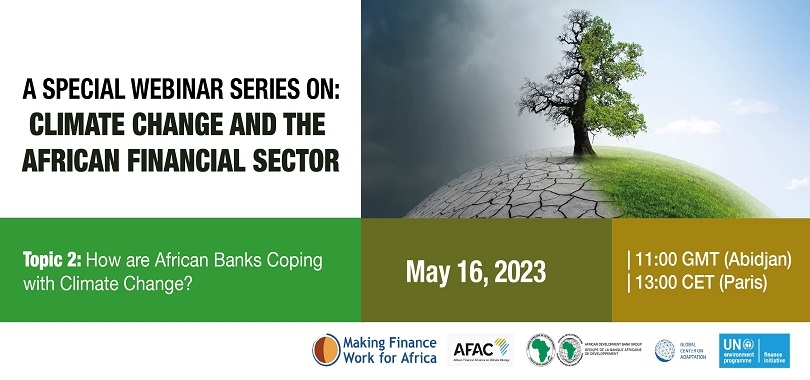
Webinar recording: How are African banks coping with Climate Change?
Climate Change and the African Financial Sector
Webinar Series
Tuesday 16 May -- The African Development Bank (AfDB), Global Center on Adaptation (GCA), UNEP FI and the Secretariat of Making Finance Work for Africa Partnership (MFW4A), in partnership with the African Financial Alliance on Climate Change (AFAC), are convening a series of webinars on Climate Change and the Financial Sector to raise awareness around the risks and opportunities. The series will consist of three/four (3/4) webinars addressing specific subjects.
The second webinar entitled "How are African banks coping with Climate Change?" discussed how climate-related risks threaten the functioning of banking institutions as well as the stability of the financial system. The discussions also shed light on initiatives of banks to implement sustainable practices and central banks to create an enabling environment for sustainable finance drawing on international best practices.
Context
Climate change and climate policy affect the balance sheets and business models of banks in different ways. African banks are vulnerable to the increasing frequency and severity of climate change shocks. Moody[1]’s expects that environmental factors will lead to a deterioration of the banks’ credit quality and profitability in the long term if banks do not take measures to prudently manage climate-related and environmental risks.
Banks in Africa are also increasingly aware of the importance of adopting green financing principles, seeking to address risks and more importantly, to grasp new opportunities. However, only 17% of banks have so far introduced specific green financing products, and these are estimated to account for only 2-20% of their portfolio[2]. Central banks and supervisory authorities play a key regulatory role. They are well placed to guide the banking sector towards supporting the low-carbon transition and implementing adaptation strategies through the application of effective financial regulation and appropriate monetary policies.
Summary
The main presentation, given by Sarah Kemmitt, Lead Secretariat of the Net-Zero Banking Alliance (NZBA), was a response to the webinar question: How are African banks coping with climate change? The presentation provided excellent data on how African banks are faring in the global context, such as their representation in the NZBA and the Principles of Responsible Banking (PRB).
Key challenges faced by African banks
For mitigation target setting, there is a lack of data on clients’ emissions, country-specific emissions factors, pathways at the country level and sectoral level for 1.5 alignment, and capacity and skills. And it is difficult to secure good consultancy services
For adaptation target setting, there is a lack of measurement approaches and KPIs.
- The financing gap: Africa will need around USD 133 billion annually in clean energy investment to meet its energy and climate goals between 2026–2030 (IEA, 2022).
- Adaptation that reduces risk is not necessarily inclusive: Conditions for adopting resiliency technologies are not always favourable, and some frontline communities are left as beneficiaries of investments.
- There are competing priorities, such as dealing with the pandemic and its aftermath, and inflation.
- The high cost of capital: it is up to 7 x more expensive than in advanced economies.
- The policy and regulatory environment is inadequate.
Key opportunities available to African banks for climate mitigation and adaptation:
- To leverage the might of the Glasgow Finance Alliance for Net Zero (GFAN) – an alliance of 8 financial sector net zero alliances, which together have over 550 members. In September 2022, GFAN launched the Africa Regional Network to support African institutions to transition to net zero.
- Africa has many of the ingredients of clean tech.
- There is an opportunity to change from the currently high-carbon intensity path and chart a new lower-emissions path for development.
- There are key opportunities to mobilize private capital, specifically through blended public-private finance to overcome the risk-return issue.
These and related issues were fleshed out further in the panel discussion that followed, with Sarah Kemmitt, the presenter; Judith Sidi Odhiambo, Head of Corporate and Regulatory Affairs at KCB Group; David Ashiagbor Chief Financial Sector Strategy Officer at the African Development Bank Group; and John Boateng Akuoko-Tawiah, Head of ESG and Climate Finance at the Development Bank Ghana (DBG).
[2] https://www.eib.org/attachments/publications/economic_report_finance_in_africa_2021_en.pdf#page=111