


Elite Networks and Venture Capital Flows in Africa
Feb 01, 2024
Introduction
Many studies emphasize country-level factors in the dynamics of venture capital (VC) investments across the African continent, while the role of networks in shaping economic outcomes is substantial yet often overlooked. The social capital of African startup founders impacts funding outcomes, leading to a novel theory of elite networks’ influence on VC investments. Semi-structured interviews[1] with stakeholders in the VC ecosystem, including entrepreneurs, students, researchers, and ecosystem builders, highlighted a pronounced bias in VC investments towards well-networked African entrepreneurs. For all the VCs interviewed, trust was one of the most decisive factors. They also admitted that the university they attended also played a decisive role in this level of confidence. Those who attended "Ivy League" universities seem more trustworthy. This trend is generally seen in countries such as Nigeria, Kenya, South Africa, and Egypt—the so-called “Big Four.” They collectively took home 51% of the $3.6 billion raised in 2023[2]. It occurs largely because of an overrepresentation of these countries' student populations at elite U.S. universities (Table 1).
Table 1: African Students at Elite U.S. Universities (2015–2020)

Source: Author’s calculations derived from publicly available international student data from websites of the top 20 U.S. schools as per ‘U.S. News World Report”.
The overrepresentation naturally extends to professional organizations like big tech companies, prominent consulting firms, and reputable Wall Street firms. The combination of those powerful credentials and networks creates an uneven playing field phenomenon in VC investment flows that we call “network capitalism.”.
Money follows familiar faces
Investments are primarily made in people rather than geographical locations. Founders with ties to elite networks and institutions attract more funding. This is evident from the large concentration of VC funding in the Big Four countries mentioned earlier (Figure 1), where there is a disproportionately higher number of people attending US elite universities relative to other African countries. For instance, between 2015 and 2020, they accounted for over 60% of the African student population at elite US universities, despite making up only 32% of the African population.
Figure 1: VC Funding and number of students graduating from US Elite Universities 2015–2020
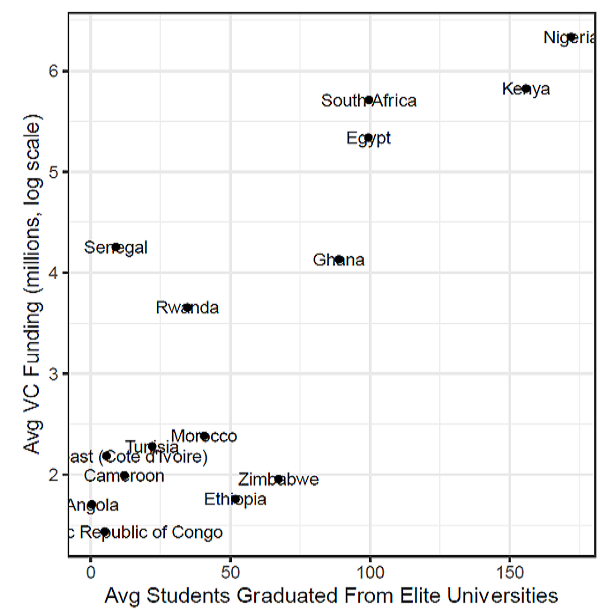
Source: Partech and the author’s compilation from Africa: The Big Deal.
As a result, they have rubbed shoulders with capital purveyors during their time at elite institutions. To illustrate this, let's think about a practical scenario: An Ivy League-educated American fund manager in San Francisco with $100 million to deploy in African startups needs a deal flow. Who does he call first? The conducted interviews revealed that first calls would typically be made to former classmates. Overwhelmingly, they will be in Lagos, Nairobi, Cairo, or Cape Town. Of the 30 deals in Nigeria and 24 deals in Kenya available in the database in 2019, 9 and 10, respectively, were carried out with founders graduating from one of the top 20 US universities (respectively 30% and 42% of the total).
That simple mechanic provides the basis for following the VC money trail on the continent.
Breaking the Status Quo
Since VC investments are largely a matter of social capital over evidence-based decision-making, the continent is ripe for a winner-take-all environment. In fact, founder credentials are often the only data points investors can initially trust. This means that countries interested in challenging the status quo should improve the competitiveness of their talent pool and equip top performers with the tools to seek world-class credentials. In addition, they should strive to build systematic pipelines to and from elite institutions, foster greater knowledge sharing, and signal business readiness. While those tactics can help catalyze more investments, they should not eclipse the need for sound policymaking and the rule of law.
The Diffusion of Norms and Values
The dominance of certain countries within elite networks leads to asymmetrical access to opportunities and resources, further entrenching competitive advantages. However, a new generation of talented individuals from less-represented countries is increasingly bridging the gap by leveraging networks and putting their countries at the forefront. These individuals need to be supported. For instance, include subsidizing the cost of their education at elite universities, championing their innovation at home and abroad, and building a regulatory framework that incentivizes them to come back home. Those are the seeds of a successful ecosystem. By diffusing global standards and best practices in their countries, they can have a tremendous positive impact on VC fund deployment. The reality is that an ecosystem can gain momentum with a handful of champions. We have seen it in Senegal with Wave and in Tunisia with Insta-Deep. In 2021, Wave attracted $200 million in investment from the likes of Stripe and Sequoia. This still represents the largest series A in Africa. This triggered a boom in new venture creation in the region. In 2023, pharmaceutical giant BioNTech acquired Tunisian-born Insta-Deep for $549 million. The deal shed light on the nascent deep tech ecosystem in Tunisia, where a new wave of startups is trying to capitalize on the country’s relatively highly skilled labor market and engineering talent.
Expanding Geographic Reach
Given the historical lack of access to traditional financing on the continent, the VC asset class will be crucial to driving growth in the future. However, for that growth to be balanced, it is important to expand the geographic reach of VC investment networks. This includes deepening ties between capital purveyors and entrepreneurs from under-represented countries and regions. This approach will not only diversify the investment landscape but also stimulate innovation and competition across the continent.
[1] Over 30 people were interviewed through face-to-face and Zoom interviews, including current students from elite universities, venture capital-backed African founders and graduates of elite universities, and investors.
Your comment