


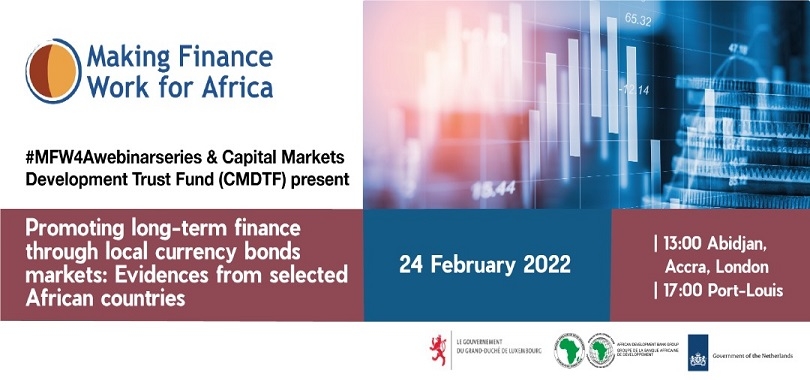
Webinar report || Promoting Long-Term Finance (LTF) through Local Currency Bonds markets: Evidences from selected African countries
A study commissioned by Making Finance Work for Africa (MFW4A) and the Financial sector development department of the African Development Bank show that Long-Term loans just account for 4% of total banks loans to the WAMU economies and it drops to only 2 % to central African economies. In fact, estimated financing gaps to achieve the High 5 priorities are significant[1]:
- Between US $60 billion and US $90 billion per year to light up and power Africa;
- Approximately US $280-340 billion over the next decade to feed Africa;
- About US $56 billion to industrialize Africa;
- About US $130–$170 billion a year to integrate Africa through infrastructure development[2];
- US $1,826 billion is needed for Information and communication technologies development[3] and;
- US $42 billion is required to allow access to finance for African women across business value chains on top of $ 937,714,513 million to develop trade and investment [4].
Meanwhile, LTF resources from domestic investors, insurance sector and capital markets remain largely untapped.
Making Finance Work for Africa (MFW4A) and the Capital Markets Development Trust Fund (CMDTF) co-hosted a webinar to boost Long-Term Finance (LTF) through local currency bond markets and mobilize domestic resources to finance development imperatives including the African Development Bank’s High 5 priorities. Financial sectors experts and thought leaders from Ghana and Mauritius, among others, shared their experiences growing their local currency bond markets to mobilize domestic resources and involve key stakeholders.
Looking at the Ghanaian local currency bond markets development, Abena Amoah, Deputy CEO, Ghana Stock Exchange reported that: “the Ghanaian market had been dominated by commercial banks but we realized in 2015 that private pension funds ̶ which had been liberalized in 2010 ̶ was growing and were actively looking for exposure to other asset classes and diversified products.” To reform the market and reach its full potential, a committee of eleven members, including the ministry of finance, the bank of Ghana, the banks themselves were tasked to organize the market and oversee overall activities. In addition, the ministry of finance decided that for two years tenure and above it, it will use the book building up approach to allow banks, stockbrokers, other financial markets operators and the private sector to lead issuance of these securities.
As a result, the market has grown significantly. In 2021, the volume of securities traded increased to GH¢ 209 billion (US $29,6 billion) up from GH¢ 5 billion (US $ 709 million) 6 years ago. While foreign investors accounted for over 60% of all trades on the market, trends flipped around after the reforms so much so that in 2021, 77% of all trades in the market were credited to domestic investors fueled largely by institutional investors. Out of the 196 securities listed, 43 are corporate owned issuances. “As in the development of many bond markets, it starts strongly with the government securities to be followed by the corporate” Abena Amoah concluded.
Mauritius’ corporate bond market has also seen some interesting development over the last 5 years according to Sunil Benimadhu, CEO of Stock Exchange of Mauritius. The total outstanding amount of government bonds issued increased from MUR 250 billion (US $5,7 billion) in 2017 to nearly MUR 400 billion (US $ 9 billion) in 2021. On the corporate bonds side that are listed on the exchange, the outstanding amount of bonds at the end of the year stood about MUR 20 billion (US $ 452,7 million) few years back to MUR 80 billion (US $ 1,810 billion) in 2021.
Commenting on the growth of corporate bond markets in Mauritius, Sunil Benimadhu said: “First we've operated regulatory changes to our listing rules for corporate bonds and secondly, as Mauritius is positioning itself as an international financial center, we gave our corporate issuers the opportunity to trade and raise capitals in their preferred currency depending on where and who the target investors are.”
Echoing statements from Abena Amoah and Sunil Benimadhu, Ahmed Attout, Manager of the Capital Markets Development Division (African Development Bank) expanded on the Bank’s initiatives to push regional regulatory reforms and create an enabling environment as well as a conducive deep and liquid African capital markets. “The Bank is focused on the integration African capital markets and introduction of new asset classes and innovative capital markets solutions including green bonds, gender bonds. Eventually, we will be able to crowd in pension funds, insurance companies while promoting access to long-term local currency funding at the regional level through multiple instruments such as technical assistance or loans” he said.
Speakers stressed the importance of regulatory reforms to enhance overall ecosystem’s flexibility, transparency, liquidity and depth. They also pointed to technology as a must to grow local bonds markets as a source of LTF: “We put in place the right technology to book and record transactions, etc.” Abena Amoah, Deputy CEO of Ghana Stock Exchange confirmed.
The use of technology as an enabler to cross-link markets will allow African brokers to trade across the continent and create an efficient, deepened and integrated African market. “This will enhance liquidity over a period of time and minimize asymmetry of information on regional and continental investment opportunities across different jurisdictions” Sunil Benimadhu, CEO of Stock Exchange of Mauritius emphasized.
As part of its strategic priority, the African Development Bank is committed to support regional regulatory reforms and mainstream use of technology to grow African capital markets as a source of LTF in RMCs. As such, the Bank and its partners has set-up the Capital markets Development Trust Fund to support risk-based supervision and real-time monitoring of capital markets activities as well as automation of issuance process for government securities in West Africa. Through the Long-Term Finance Initiative platform, the Bank and its partners are tackling issues related to availability of accurate and up-to-date financial markets data. The platform includes a scoreboard with key indicators on the provision of LTF on the continent and country diagnostic reports highlighting capital markets development challenges and suggesting structural, institutional and legal and regulatory changes.
For more details on the webinar series and to listen to recordings visit: https://www.mfw4a.org/events/webinar-report-promoting-long-term-finance-ltf-through-local-currency-bonds-markets . The next session (in English) is scheduled for 24th March and will explore how banks assess climate risks and integrate them into credit risk assessments.
[1] 2021. AfDB. “The high 5 for transforming Africa”. Online. https://www.afdb.org/en/high5s
[2] 2020. AfDB. “African Economic Outlook 2019”. Online. https://www.icafrica.org/fileadmin/documents/Publications/AEO_2019-EN.pdf
[3] Idem
[4] 2019. AfDB. “Why Affirmative Finance Action for Women in Africa (AFAWA)?”. Online. https://www.afdb.org/en/topics-and-sectors/initiatives-partnerships/afawa-affirmative-finance-action-for-women-in-africa/why-afawa